Oregon WildBlog
Oregon Wild Blog RSSNews, notes, trip reports, and the lighter side (of the wilder side) of the Oregon environmental and conservation movement.
Mushroom of the Week - an artist's palette
A fungus that both graffiti artists, as well as “true” artists can appreciate.
Artist’s Conk, Gandoderma applanatum
Superficially, the Artist’s Conk looks much like last week’s featured bracket fungus species: the Red-belted Conk, Fomitopsis pinicola. The Artist’s Conk is perhaps only second in abundance to the Red-belt Conk, and has a similar grey, brown to black upper cap surface.
The Artist’s Conk notably lacks the Red-belted Conk’s sometimes red to orange outer band. Instead, the Artist’s Conk often appears a cocoa-brown color due to its abundantly produced spores. One normally expects the spores, that are produced from pin-prick size holes on the mushroom under surface, would not be found on top of the cap. However, the Artist’s Conk mushroom produces so many spores they seem to blow around elsewhere, even settling on top of the cap.
It is reported that a mature Gandoderma applanatum, up to about 30 inches across, can produce 30 billion spores a day continually for 6 months of the year. This pencils out to a seasonal total of 5 trillion spores!
Can timber pay the bills?
With the release of an alternate plan for county funding, a central question crops up again - does logging actually pay (enough)?
Today, Oregon Wild joined with six other conservation groups to unveil a new plan to fund Oregon's rural county governments that face a funding shortfall in the wake of the expiration of Secure Rural Schools legislation.
Environmentalists proposing solutions to fund county governments, you scoff! I know, even we think it's strange sometimes.
The problem is, absent any new ideas to figure out funding for the 18 O&C counties, politicians always seem to turn to funding models taken straight out of the 1980s. In fact, some recently proposed plans for county funding are so three-decades-ago that they might as well be set to a nice disco tune.
Mushroom of the Week - 'Conked' out
While you really can’t eat it, if lost in the woods on a cold winter night, this particular “mushroom” could possibly help save your life!
Red-Belted Conk, Fomitopsis (Fomes) pinicola
When the weather turns cold, wet, and even snowy, there is one group of fungi that can always still be found attached to branches and trunks in our Northwest woods. These are the Polypores—so named for the multitude of tiny pores that release spores from their generally smooth appearing under surfaces.
This particular perennial fruiting body, the Red-Belted Conk, appears shelf-like on the sides of old or dying trees, and where within the tree it forms a cubical brown rot on both the sapwood and heartwood. As such the Red-Belt Conk plays a major ecological role in creating soft wood cavities in snags and ultimately in the recycling of forest’s no longer living woody fiber back to nutrient rich soil.
Bill's Excellent Adventures - Bogs and bigfoot
The mysteries of Gold Lake's bogs has our guide book author on the look out for a mythical creature.
“Have you ever run across any sign of Bigfoot?”
I get calls like this occasionally. The man on the phone had first asked if I was indeed the guidebook author who explores remote corners of Oregon. He hadn’t given his own name.
“Actually, I never have met Sasquatch,” I admitted. “Why do you ask?”
“Well,” he said, “I have this theory. I’ve been looking at maps and think he might be hiding out in the Gold Lake bog.”
I had to admit I’d never looked there. The bog is a square mile of floating sphagnum behind Gold Lake, in undesignated wilderness land south of Waldo Lake. Unless the mythic ape man is amphibious, it would be a hard place to hang out.
But the conversation stuck in my mind, perhaps because I really didn’t know what was in the bog. Eventually I decided it might be interesting, and relatively easy, to check it out in winter, when the swamp is frozen solid.
I’d been to Gold Lake countless times on skis and snowshoes. It’s a classic first trip of the winter season. Nearly level and only 1.8 miles long, the Nordic ski trail leads to a rustic shelter by the lake. From there, the bog is just a mile across the lake.
Starting point for this adventure is the Gold Lake Sno-park, half a mile west of Willamette Pass on Highway 58. From there you cross the highway and then ski the snowed-under Road 500 to Gold Lake.
Check carefully before venturing out onto the frozen lake. Snow can insulate the surface, leaving slush instead of ice underneath. On the far shore of the lake, the bog is great ski terrain, with little hummocks and a view south to Diamond Peak.
I didn’t see any sign of Bigfoot. Still, I wondered, is a lack of giant footprints conclusive evidence?
Once a woman who writes very nice poetry asked me the question I’d heard from the man on the telephone, “Have you ever seen any sign of Bigfoot?”
I told her no.
“That figures,” she said, nodding. “Sasquatch doesn’t reveal herself to just anyone.“
So who knows? Maybe he -- she? -- really is hiding in Gold Lake’s bog.
William L. Sullivan (www.oregonhiking.com) is the author of "Oregon Favorites", available in all bookstores. Six of Bill's sixteen books are now available in electronic format at http://www.smashwords.com/books/view/38219.
Mushroom of the Week - Tardy mushroom with some tartar sauce
One oyster mushroom it’s OK to show up late for.
Late Oyster Mushroom, Panellus serotinus
The Late Oyster Mushroom, Panellus serotinus, could be easily confused with or mistaken for the real Oyster Mushroom, Pleurotus ostreatus (last week’s featured species). Were you to so confuse it for the real Oyster Mushroom, you’ll find your mistake to be far less tasty, but fortunately, not life threatening. While technically edible, the Late Oyster is definitely a far less delectable species than Pleurotus ostreatus. Although a handsome looking fungus in its own right, the Late Oyster Mushroom is quite tough, and to be eaten must first be cooked for a considerable length of time. Also, older specimens may be bitter tasting.
Barely enough snow for 1st snowshoe of the year
Westview Snowshoe Loop trip report from January 12, 2012
You might say that the 2011-2012 winter is off to a slow start, precipitation-wise. The Willamette Pass ski area, southeast of Eugene, only reached adequate (barely) snow levels to open a week ago. At the nearby Gold Lake Sno-park, where I led the first Oregon Wild snowshoe hike of the year yesterday, there was only about 1.5 feet of snow. Packed, icy, snow.
Going off the rails with the Rocky Mountain Elk Foundation
A once-proud conservation organization seems to be turning its back on science and common sense.
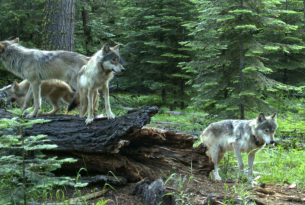
Gray wolves have a way of igniting fierce debates. Working to promote wolf recovery in Wallowa County, we here at Oregon Wild are used to that. However, even the most jaded Oregon Wild staffer wasn’t quite prepared for some outlandish comments made by Rocky Mountain Elk Foundation (RMEF) President David Allen last week.
Mushroom of the Week - Forest shellfish
Oysters that grow on trees.
Oyster Mushroom, Pleurotus ostreatus
While equating this species with oysters may be a bit of a stretch, some people do maintain that when they are breaded and fried they do have a mild flavor slightly reminiscent of seafood.
While Oyster Mushrooms can, of course, just be sautéed in margarine or butter, I prefer to first plop them into some raw scrambled eggs, and then dip them in seasoned bread crumbs before placing in the frying pan. While rated highly by many, it is still a mild flavored mushroom, that compared to seafood, is at best, probably more like a very mild white fish--like some anonymous tasting tilapia filet.
Don't stop believin'
As Journey the wolf continues his long journey, NBC's Brian Williams gets in on the news.
When my colleagues Steve Pedery, Rob Klavins, and myself sat down in November to talk about the traveling wolf "OR-7" we had no idea just how far this wandering wolf would go.
We also had no idea how far the brainstorm we came up with that day would go.
We figured OR-7 needed a legitimate name. He'd already become the first wolf west of the Cascades in 65 years (and would soon become the first wolf in California in almost a century). A celebrity of his status needed to be know by a name other than one ascribed by the collar around his neck.
Mushroom of the Week - Cloudy, with a chance of mushrooms
Finding clouds with generally odd smells.
Cloudy Clitocybe, Clitocybe nebularis
A fairly common cold weather mushroom, found both under our conifers, but also below hardwood tree species, is the Cloudy Clitocybe, Clitocybe nebularis.
Clitocybe means “sloping head” in reference to gills of most species in this genus, that usually are decurrent--meaning they extend from under the cap on down the stem. The species epithet “nebularis” means “cloudy” from the Latin root “nebula” originally meaning vapor or smoke.